
Fields in Newton County Property Tax Records
Two offices split the work in Newton County. The Assessor builds the roll, while the Tax Collector issues the bill and takes payment, so reading both Newton County property tax records keeps a value field from being mistaken for a balance.
| Field | What It Shows | Where |
|---|---|---|
| Land assessment | Tax-roll value for land | Assessor and GIS |
| Improvement assessment | Tax-roll value for structures | Assessor and GIS |
| Total assessment | Combined assessed amount | Assessor roll |
| Homestead code | Exemption treatment for the cycle | Assessor record |
| Bill & status | Amount billed, paid or delinquent | Tax Collector |
Mississippi's statutory ratio system produces the assessed value. That figure is not a recent sale price, a private appraisal, or the amount due on the bill.
Newton County's True-Value Formula
The formula comes from the Mississippi Department of Revenue: true value times the assessment ratio, then times millage. Class I is 10 percent. Class II is 15, and one mill is one-thousandth.
Four terms to separate
True value is the appraisal base, assessed value follows the class ratio, and millage applies the levy. Homestead exemption is claimed relief.
The ratio is a statutory calculation step, not a discount.
Search Newton County Assessment Fields
The Delta Real Property Appraisal page for Newton County advertises searches by name, address, parcel, and PPIN. A subscription notice guards the detailed access.
| Name | Owner lead on the roll |
|---|---|
| Address | Known situs street |
| Parcel | Formatted tax-map key |
| PPIN | Numeric bridge across county systems |
The official page shows routes, not sample valuation cards.
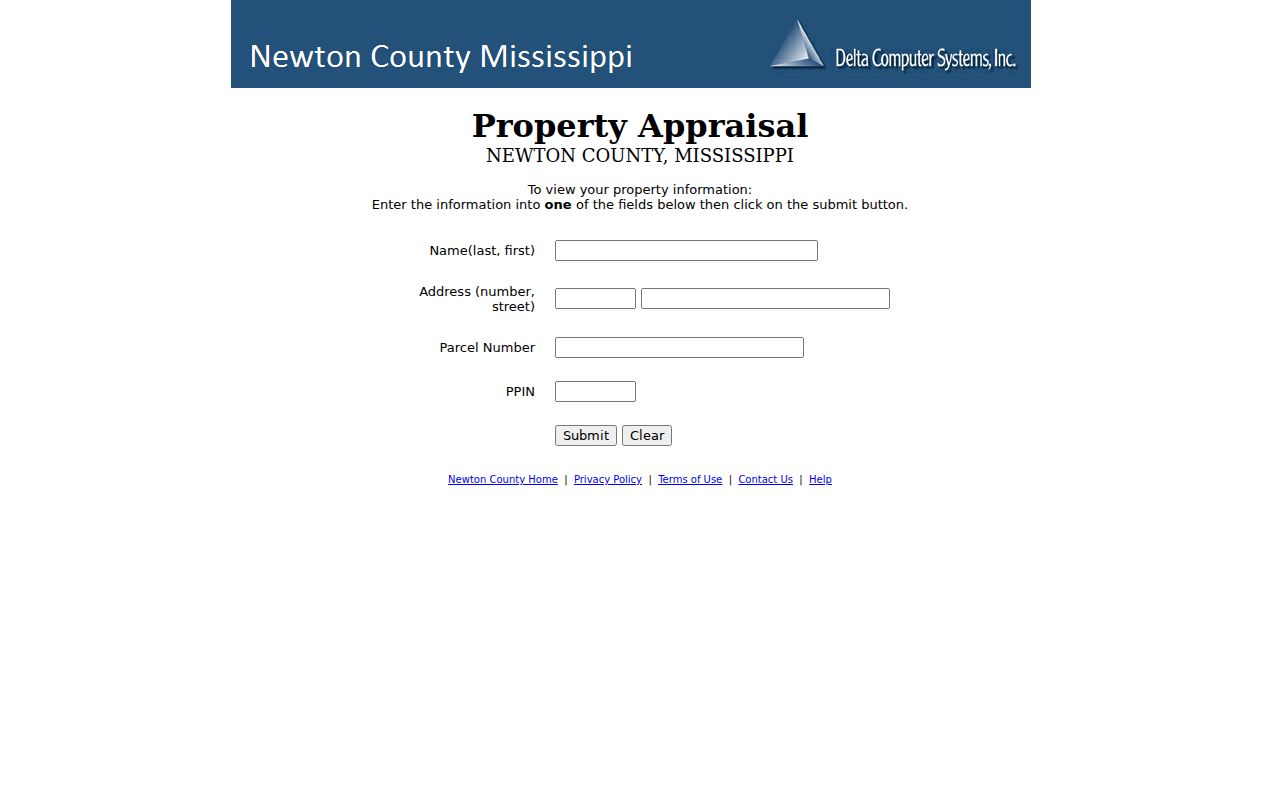
Use the free Property Link first. Ask the Assessor at 601-635-2517 when subscription detail is unavailable.
Look Up a Newton County Tax Bill
The Newton County Tax Collector site is the source for bills, payments, and delinquency. Keep the parcel and year visible throughout.
- Find the parcel by address, owner, parcel number or PPIN.
- Select the correct tax year and account.
- Read the bill, payment or delinquency status.
- Compare homestead and tax-district fields with the assessment roll.
The captured Collector landing page separates ordinary payment guidance from the annual tax-sale path.

Confirm any changing payoff by phone, not an old screen.
Newton County's January 1 Owner Cutoff
Newton County tax statements carry the name of the person who held title on January 1 of that tax year. The Tax Collector works from that annual roll. So when a parcel sells in, say, March, the bill for that same year still shows the prior owner of record. Nothing is wrong with the record. The cutoff simply predates the sale.
To see who truly holds the property now, line up the parcel number and legal description first. Then look for the most recent deed recorded with the Chancery Clerk. A recorded deed dated after January 1 will show the transfer that the tax roll has not yet caught up with.
Note: The name on a statement reflects the owner on the January 1 tax roll, not a later buyer who acquired the parcel that year.
Newton County Tax Dates and Installments
Statements are usually mailed the week before Thanksgiving. The local site asks taxpayers to call if one has not arrived by December 15. Taxes are due February 1. At least half may be paid then, with interest on the balance. County sources describe the interest differently, so confirm the current rate with the Collector before relying on either figure. The delinquent sale falls on the last August Friday.
Claim Newton County Homestead Treatment
DOR's homestead window runs January 1 to April 1. The department also describes added relief for qualified owners age 65 or older or totally disabled. Exemptions are not automatic. The taxpayer must claim and prove a statutory exemption. A homestead code shows roll treatment for one cycle, not a permanent title fact, so ask the Assessor what proof and updates are required.
County Tax Sale Versus State Forfeiture
The annual county sale and the SOS tax-forfeited search are two different workflows. The state form accepts county, address, subdivision, parcel, and PPIN. It also takes assessed owner, value, and legal-description fields. A statewide listing is not an ordinary unpaid bill. A published notice does not prove a conveyance was completed.
Reconcile Newton County's Roll, Bill, and Deed
Three dates usually explain an apparent conflict in Newton County. The first is the January 1 ownership date used on the tax statement. The second is the effective assessment year. The third is the date a later deed reached the record. Start with the PPIN and parcel number. That anchor keeps every comparison attached to the same tract. Then copy the owner name, mailing address, tax district, exemption code, land assessment, improvement assessment, and total assessment from the parcel record. Keep the Collector's tax year and payment status on a separate line.
A different owner name is not a reason to change the parcel match. Inspect the latest deed through the Chancery Clerk instead. Differing acreage or improvements call for a comparison of the GIS acres, the legal description, and the current property card. They also call for any survey or building data available to the Assessor. A mailing address never fixes a parcel's location. Newton, Decatur, Hickory, Union, or another place name only shows where the mail goes. The parcel service's CITY field works the same way.
The DeltaProperty Link accepts name, address, parcel, PPIN, and section-township-range searches. Frequent uploads can still lag the courthouse. That warning supports a two-office check after a recent conveyance. The Assessor explains the roll cycle. The Clerk supplies the recorded land instrument.
Obtain Newton County Property Tax Records Offline
Phone and counter access still matter when a portal is missing a historical year or simply unavailable. The Newton County Tax Assessor and Collector, at 601-635-2517, handles ownership maps, assessment entries, exemption treatment, statements, receipts, payment status and delinquency questions. Direct each question to the office that created the record, since no single screen answers both valuation and collection issues. For deeds, Board of Supervisors records and recorded tax-related instruments, call the Chancery Clerk at 601-635-2367 or visit 92 W Broad Street in Decatur, weekdays from 8:00 a.m. to 5:00 p.m.
A focused request should include the PPIN, parcel number, owner name as printed, situs, tax year, the exact record desired and a preferred format. Under the Mississippi Public Records Act, a public body generally produces or denies a request within seven working days, or explains why a longer reasonable period is needed. Ask about the current copying cost before ordering, since fees can change.
Older tax research may lead to archives rather than the current Collector. MDAH's Newton County holdings include certified tax-levy orders from 1852, 1853, 1855, 1858 and 1867, plus a 1911 personal tax roll. These records can establish period tax administration or offer a name-place clue. Cite them by series, box, volume or reel, and do not confuse them with a current real-property account on the tax roll.
Follow Newton County Tax Notices to the Final Record
Tax notices in the Newton County Appeal from April 2025 mixed tax-title and quiet-title matters with substituted-trustee and heirship items. A newspaper notice offers names, dates and legal-description clues. That is all it is. The notice describes a procedural step, pending or completed, only as stated. Trace it forward. Take it to the Collector, the Clerk or the court file, then to any resulting deed or order.
The annual county sale the Collector describes is not the same thing as land already sitting in the Secretary of State's tax-forfeited inventory. When you search that state inventory, use county, parcel, PPIN, subdivision or legal description rather than an owner name alone. Names repeat. Parcels get confused. Before treating any status as final, request a current payoff, redemption, sale or conveyance record from the custodian responsible for it. An archived notice, a stale portal entry or a similarly named parcel is not proof of present tax standing.
Contest a Newton County Assessment
Real property in Newton County is revalued at least every four years. The Assessor performs the local appraisal. The Board of Supervisors approves the tax roll and hears objections. Start by confirming the parcel data and the class. Check the land and improvement entries before you argue value. Strong evidence includes the property card, photographs, a survey and a corrected legal description. Records of removed or misclassified improvements also help.
Protect the appeal window. DOR says objections normally reach the Board by the first Monday in August before the due date; verify the local calendar with the Chancery Clerk.