
What Newton County Deed Records Convey
Every recorded instrument names the parties, carries a recording reference, and states execution or filing dates alongside the land description. Read the label before assuming anything. Not every filing moves ownership. Deeds of trust, assignments, substitutions, releases, liens, lis pendens, plats, and court-derived instruments all share shelf space with deeds in the same land-record system, so the label tells you what the paper actually does.
| Deed Type | What It Does | Common Use |
|---|---|---|
| Warranty deed | Conveys the stated interest with title covenants | Ordinary purchase and sale |
| Quitclaim deed | Transfers only the interest the grantor may hold | Family or title cleanup |
| Trustee deed | Conveys through an authorized trustee | Trust or foreclosure transaction |
| Executor deed | Transfers under estate authority | Probate-related conveyance |
| Tax deed | Records a conveyance following the applicable tax process | Delinquent-tax property |
A deed of trust, for instance, secures an obligation rather than conveying ownership. That distinction matters. Follow any release or substitution tied to it. A tax-sale notice or substituted-trustee notice is likewise just one step in a process, and by itself proves nothing about whether a final deed was ever issued and recorded.
Use the Newton County Chancery Land Index
The Chancery Clerk in Decatur keeps the deeds, deeds of trust, liens, plats, and land indexes. The office sits at 92 W Broad Street. LTAMS reports online land-record coverage from the 1970s to the present. Online access through the Syscon route can be inconsistent. The dependable paths are the public counter or terminal, a telephone call to 601-635-2367, mail, and a focused written public-records request. Each one reaches the same books.
| Party name | Search grantor and grantee, including initials, suffixes, former names, and entity variants |
|---|---|
| Date range | Narrow a known transfer while leaving room for delayed recording |
| Book and page | Request the exact instrument referenced in parcel data |
| Legal description | Match the land rather than relying only on a street address |
| Instrument type | Separate conveyances from liens, releases, plats, and notices |
The Clerk publishes no exact digital cutover date and no guarantee that every index result carries an attached image, so ask before treating an online name hit as the complete document.
Match Book, Page, PPIN, and Description
The Newton Parcels service publishes PPIN, parcel number, owner name, deed book, and deed page. It also carries deed type, deed date, sale fields, legal-description segments, subdivision, and GIS acreage. Treat those fields as a bridge. They are not a substitute for the recorded image. Sample parcels show how the cross-reference works: one lists book 297, page 175, with a 2001 deed date; another lists book 217, page 826, with a 1989 deed date. Neither sample is a title opinion. Copy the reference exactly. Compare the polygon against the written description, then request the underlying document. If book and page disagree with the owner of record, search the later party and date range. Do not force the parcel card to answer a deed question.
The county links a Chancery search page. LTAMS documents it at this address. The page displays the reported 1970s-forward coverage in its service details. Portal availability and image access still depend on the Clerk.
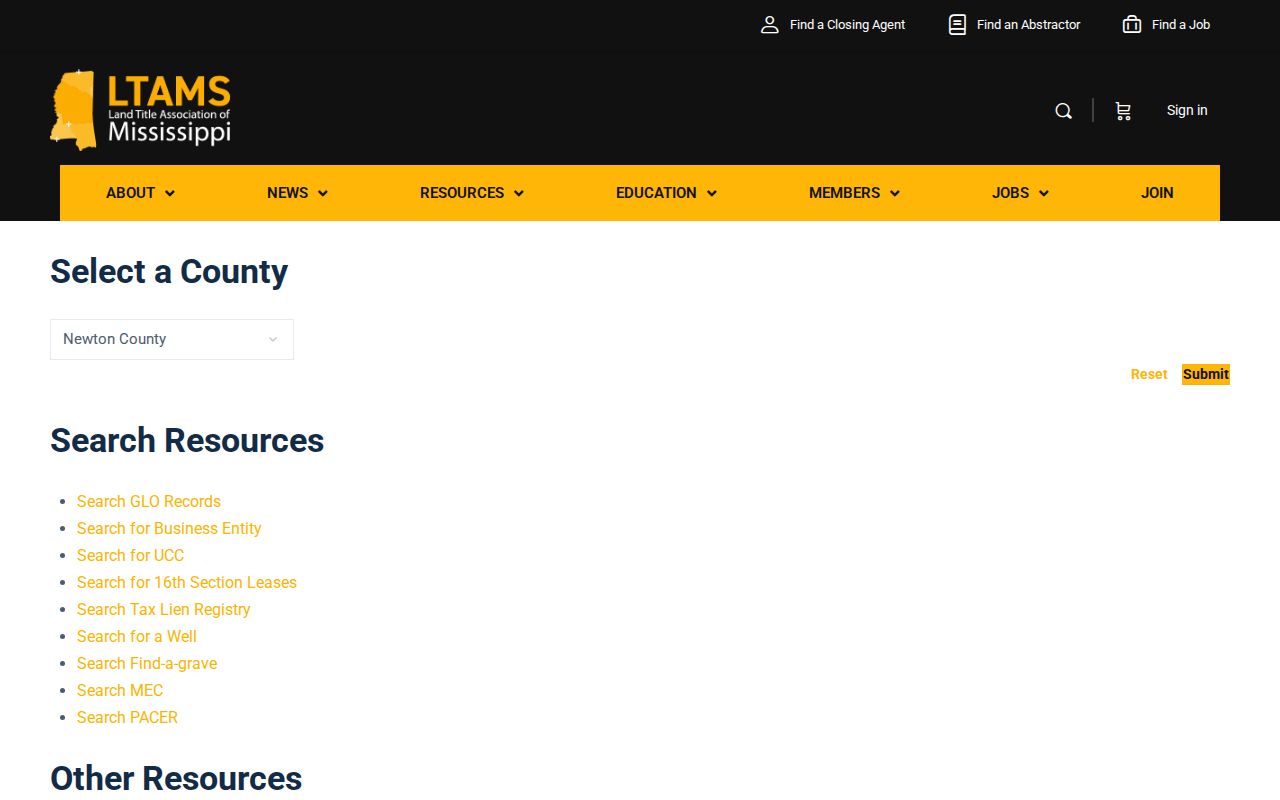
It reports coverage running from the 1970s forward, while current portal availability and image access still require confirmation from the Clerk.
Read Newton County Legal Descriptions Carefully
Legal descriptions come in three main shapes. Lot-and-block language points to a recorded subdivision plat. It often includes its own map book and page. Section-township-range descriptions organize rural land on the federal survey grid. Metes-and-bounds text walks the boundary through calls, distances, roads, creeks, adjoining owners, and monuments. A historic deed may omit any modern address at all.
Land-record terms
- Grantor
- The party transferring the stated interest.
- Grantee
- The party receiving that interest.
- Chain of title
- The ordered sequence of instruments tied to the same land.
- Book and page
- The recorded-document reference used in Newton parcel data.
Parcel numbers change. A split, a merge, or a remapping can renumber the same ground overnight. The legal description usually supplies the stronger continuity clue, especially where older records lean on a railroad, a school, a cemetery, a creek, a former owner, or a courthouse landmark to pin the land down.
Walk Newton County's Grantor-Grantee Chain
Start the chain from the newest confirmed conveyance, never from an unverified owner-name result. Then work backward one document at a time, keeping every citation and legal description with you as you go.
- Use the current parcel's deed book/page and grantee to request the newest matching deed.
- Read the grantor, legal description, execution date, recording date and nature of the estate conveyed.
- Search that grantor as an earlier grantee, checking spelling, initials, entity names and estate roles.
- Repeat until the chain passes beyond online coverage, then continue through Clerk books, plats, microfilm and archives.
- Name variation
- Search initials, suffixes, married or maiden forms, “et al.,” and fiduciary roles.
- Estate link
- Reconcile executor or administrator authority with the recorded conveyance.
- Court link
- Follow a quiet-title, foreclosure, or partition result to the resulting land instrument.
For rebuilding the full backward timeline, the former-owner guide goes deeper. Here the goal is simpler: find each deed and read it correctly.
Continue Before Newton County's Online Cutoff
The Mississippi Department of Archives and History finding aid covers Newton County government records from 1831 through 1979. MDAH also lists Chancery abstract books and 16th Section abstract books through 1912. Closer to home, the Newton County Historical and Genealogical Society keeps local newspapers and research collections. These include The Newton Record from 1901 through 2009 and Union Appeal from 1936 through 1979. Those layers matter because records have burned here. FamilySearch's WPA newspaper catalog reports fires in 1876 and 1910 destroyed some county records. A missing deed reference should be tested against surviving indexes, plats, tax rolls, court minutes, and newspaper notices. Offsite microfilm helps too. Note what each item is. Record whether it is an original, an image, an index, a transcript, or an abstract. Note as well whether an item is a secondary account. A newspaper sale notice can reopen a dead lead. It never replaces the instrument itself.
Request Newton County Deeds Through Every Channel
For a recent record, try the online index first. Then call the Chancery Clerk or work the courthouse terminal and books in person. A mailed or written request should supply party names and an approximate date. Add book and page if known, instrument type, parcel or PPIN, and the legal description. State whether you want an ordinary copy, a certified copy, or inspection. Ask the office to quote the current fee. It publishes no fee schedule for copies.
Under the Mississippi Public Records Act, keep the request narrow: name the record and the preferred format. Public bodies generally produce or deny within seven working days. They can also explain why they need a longer reasonable period. Older searches can move on to MDAH, the local historical society, MSU newspaper microfilm, or FamilySearch material. Newton County offers no official property-fraud alert signup. Owners should ask the Clerk whether one has been added.
Verify a Newton County Deed Copy
Finding the right entry is only the start. Match the copy page by page against its index citation. Check the names, the acknowledgment, and the full legal description. Attachments and the recording stamp deserve the same close look. So do the book and page numbers and any cross-references. A certified copy works differently. Some agencies or legal proceedings will only accept the custodian's certification. Settle that question with the recipient before you order anything from the Clerk.
Recorded is not guaranteed. Newton County deed records show instruments accepted for recording. They do not establish that title is clear, resolve a boundary, or reveal every possible unrecorded interest.
Some deed questions go beyond what a copy can settle. For a purchase, disputed ownership, an easement, an heirship dispute, or a tangled chain of title, bring in a qualified Mississippi attorney or title professional. Keep the Clerk's certified record separate from parcel data, an appraisal screen, a newspaper abstract, or a court docket summary, since each serves a different purpose.