
Identify Who Owns a Newton County Property
Newton County's practical route to an owner links three sources: the Delta land roll, the county parcel layer, and the Chancery Clerk's recorded instruments. Start with the strongest key you have. A PPIN or parcel number outlasts any street spelling. An address is often the easiest way in. Keep every identifier that surfaces, because it will help reconcile the next source.
- Enter the address in Delta Property Link, then record the displayed owner name, parcel number, PPIN, and legal-description clues.
- Compare those identifiers with the Newton Parcels layer, especially the NAME, situs, mailing, and deed-reference fields.
- Use the newest deed book/page or instrument reference to ask the Newton County Chancery Clerk for the latest recorded conveyance and identify its grantee.
- If the grantee is an entity, verify its status and filing details in the Mississippi Secretary of State Business Search.
Work the sequence from weaker records to stronger ones. The roll gives the current administrative lead. The deed supplies the actual recorded transaction. Never assume the person at the property, or the mailing address on file, is the owner of record.
Trace a Newton County Address to Its Tax-Roll Name
Delta Property Link accepts several search keys. You can enter a name, an address, a parcel number, a PPIN, or Section/Township/Range fields. The address works well for a known house. Rural tracts and changed road descriptions often respond better to the PPIN. They also suit the survey-grid boxes. A separate Real Property Appraisal route offers more detailed appraisal access by subscription. For free public entry, Property Link is the start. The parcel service and a call to the office complete the chain.
| Search key | Best use | Check next |
|---|---|---|
| Address | Known situs with a stable street number | Match PPIN and parcel number |
| Owner name | Finding parcels listed to a known person or entity | Try initials and name variants |
| PPIN or parcel | Carrying one tax parcel across systems | Match deed book/page |
| Section/Township/Range | Rural land without a reliable street key | Compare legal description |
A zero result does not mean no property record exists. Spelling quirks, annual uploads, mailing-city values, and older land descriptions can each break a simple query, so try other keys before giving up.
Note: The observed parcel service used CITY as mailing data, so it should not be treated as an incorporated-boundary filter.
Read the Newton County Parcel Card as a Lead
The parcel card exposes a rich set of fields: NAME, mailing lines, street number and name, parcel number, PPIN, subdivision, deed book, page, and date, sale fields, assessed values, homestead code, legal-description segments, and GIS acreage. That is a lot of leverage. Before asking who owns it, use these fields. They test whether two records actually describe the same land. The Newton County Delta appraisal search interface is the page that reaches owner, address, parcel, and PPIN records for the assessor.
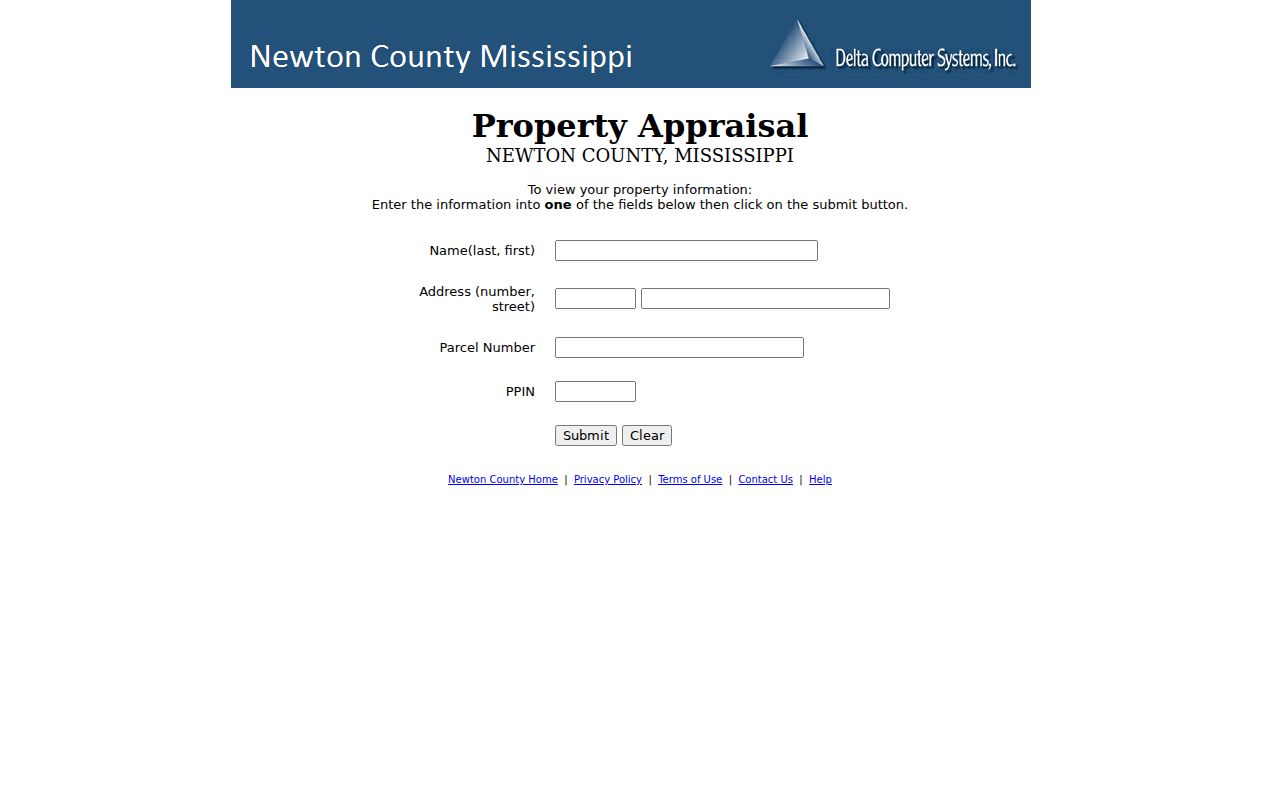
That appraisal page also carries a subscription notice. When detailed access sits behind it, the courthouse, Property Link, and the parcel layer remain the practical alternatives.
Why Newton County's January Owner Can Lag
The Newton County Tax Collector prints the owner shown on a tax statement as the owner of record on January 1 of that tax year. When a closing happens later and the deed is recorded after that cutoff, the statement keeps the prior name until the next tax roll cycle. Delta uploads can also trail courthouse activity, and the county publishes no fixed refresh interval for them.
Recent transfer: When the roll and deed conflict after a sale, request the newest recorded conveyance by book/page and date from the Chancery Clerk.
That is why an assessor name is a lead, not final proof. The Newton County current owner guide concentrates on checking that present-tense record against the deed.
Recognize Newton County Trust, Estate, and Entity Names
The owner field may show an LLC, a trust, an estate, a life-estate notation, an executor, an administrator, or several names ending in "et al." Search the exact displayed form first. Then try initials, suffixes, married or maiden variants, and role words. For an entity, the Secretary of State record can reveal filings and a registered agent. Even so, the county deed still controls the land-record trail.
Four owner terms
- Owner of record
- The name carried on the assessment roll for its current cycle.
- Grantee
- The party receiving an interest in a recorded deed.
- Situs
- The physical location of the taxable parcel.
- Mailing address
- The destination used for owner notices, which may be elsewhere.
Estate ownership can require two pieces: the Chancery estate file and a later conveyance by the executor, administrator, or heirs. Court authority explains a transfer. The resulting instrument still belongs in the land index, so follow it there.
Where Newton County Property Ownership Appears
No single Newton County source answers every ownership question. The Tax Assessor keeps the roll and the ownership maps, GIS ties the tax parcel to deed and value fields, and the Chancery Clerk holds the recorded conveyances. Their dates and purposes differ, so each plays its own part.
| Where ownership is shown | What it contributes | How current |
|---|---|---|
| Assessment roll / Property Link | Owner name, mailing data, PPIN, parcel key | Annual roll with possible upload lag |
| Chancery land index | Grantee and recorded transfer reference | Newest recorded deed is the recent-transfer check |
| Newton Parcels layer | NAME, parcel geometry, deed and legal-description links | Update date is not stated |
| Secretary of State | Entity filing and registered-agent trail | Current filing status, not land title |
For offline help, call the Tax Assessor at 601-635-2517 or the Chancery Clerk at 601-635-2367. The Clerk's land-record counter sits at 92 W Broad Street in Decatur. It is open Monday through Friday, 8:00 a.m. to 5:00 p.m. Ask for an index search. You can also ask for a deed by party, approximate date, book and page, parcel, or legal description. A narrow written request under the Mississippi Public Records Act works too.
Confirm the Newton County Owner Through the Deed
The Chancery Clerk records deeds, deeds of trust, assignments, releases, construction liens, federal tax liens, lis pendens, and plats. For the ownership question, follow the latest conveyance whose legal description and parcel references match the subject land. Write down the grantor, the grantee, the deed date, the recording date, the deed type, and the book and page. The grantee name alone is never enough.
The professional LTAMS Newton County directory reports land records online from roughly the 1970s to the present, though the linked search is not always reachable. The courthouse counter is therefore an essential channel, not merely a fallback. Older deed books and microfilm remain available through the Clerk and the Mississippi Department of Archives and History.
A deed of trust identifies secured debt. It does not transfer ordinary ownership to the lender. Releases and substitutions explain that encumbrance trail. The vesting deed, by contrast, names the estate actually conveyed, and it is the instrument that settles the question.
Note: Carry the PPIN, legal description, and deed book/page together because names and street descriptions can change between systems.
Use Newton County City Permits for Context, Not Ownership
A permit or code record tells you who applied for work. It never conveys the parcel. Newton and Decatur each run their own municipal permit routes. Hickory publishes no public permit search. For the owner of record, county deed records still carry the weight. The assessment roll does too.
Resolve Newton County Owner Mismatches Before Relying
An owner mismatch has to be dated and explained. Set the tax statement's January 1 owner beside the deed date and the recording date. Add the Delta or GIS observation date too. Then ask whether the legal description covers the whole parcel or only part of it. A split, a lot combination, a life estate, estate administration, a quiet-title action, or a trustee sale can all make property records look inconsistent. A slow upload can do the same. They may simply document different stages.
Chancery records are where many of those gaps get sorted out. Request the land instrument, deed of trust, assignment or release, lis pendens, Chancery case, estate file, and recorded plat separately. One request label will not pull all of them. Circuit judgments travel through the Circuit Clerk. Where a court order approved a transfer, follow up afterward. Get the commissioner, executor, administrator, or trustee deed that landed the result in the land index.
Public notices offer timing clues only. April 2025 issues of the Newton County Appeal carried substituted-trustee, tax-title, quiet-title, and heirship matters. A published notice can run before a sale or judgment is final. Match its parties and legal description to the Clerk file and the recorded outcome. Only then should you change your owner conclusion.
Note: A notice, map popup, tax statement, and deed can show different stages, so compare their dates and legal descriptions.
Protect a Newton County Ownership Search From Scams
Public owner names and deed references get copied into official-looking solicitations. Verify any demand through the county website or the courthouse number. Never use a number printed in an unexpected letter. The Clerk can explain its copy procedure and the current charge. A commercial property profile offer is not a county bill. A tax-sale message is not proof a parcel actually sold.
A suspicious LLC name deserves a cross-check. Compare the Secretary of State filing against the county deed record. Do not treat either one as self-proving. Mississippi flagged fraudulent business filings in June 2025 and added a Business Fraud Declaration Form in July 2026. That remedy fixes the business record only. A disputed land instrument still belongs with the Chancery Clerk and proper legal process.
Keep sensitive identifiers out of your notes. The Chancery MEC notice warns against Social Security and tax-identification numbers. It also flags birth dates, minors' details, financial-account numbers, and home addresses except where procedure requires them. Take only the public material you need to identify the parcel and the transaction.
Know the Limits of a Newton County Owner Lookup
A public tax roll can name a listed owner. It cannot say who occupies the land, settle competing interests, or deliver a title opinion. Trust terms, life estates, unrecorded interests, probate orders, liens, easements, and recent transfers may call for more records. Some of these may call for legal review. The Safe at Home address-confidentiality framework can also explain a substitute mailing address. It leaves the legal description untouched.
Lawful use. Newton County owner information supports purchase research, boundary questions, estate work, and civic review. Using it to stalk, threaten, target, or harass any person is prohibited.
Do not republish identifiers a custodian has redacted. Confirm any record through the office that holds it before you rely on the result. A qualified Mississippi attorney or title professional should handle a disputed ownership interest.