
Compare Newton County Property Value Types
Newton County records place tax figures and transaction figures close together. Their labels and purposes differ. Before comparing one parcel with itself over time, or with nearby land, identify the source and the date of each number.
| Value type | Meaning | Record source |
|---|---|---|
| True value | The Assessor's full-value basis before the class ratio | Assessment process |
| Assessed value | True value multiplied by the statutory class ratio | Roll and parcel data |
| Last sale price | A reported transaction figure, subject to its date and verification field | Deed and parcel sale fields |
| Land / improvement | Components contributing to total assessment | Parcel and appraisal records |
Mississippi class ratios drive part of the gap. Class I is owner-occupied single-family property. It is assessed at 10 percent of true value. Class II covers other real property. That class is assessed at 15 percent. The ratio is a statutory calculation step, not a market discount on the parcel.
Understand Newton County's Value Ratio
The Mississippi Department of Revenue formula runs true value times assessment ratio, then millage. Class I uses 10 percent. Class II uses 15 percent. Millage enters later in the calculation and should never be confused with the class ratio itself.
Value vocabulary
- True value
- The full-value appraisal basis.
- Assessed value
- True value after the class ratio.
- Assessment ratio
- The statutory percentage assigned by class.
- Sale consideration
- A reported conveyance amount that may need context.
- Revaluation
- The periodic update to real-property values.
For bills, exemptions, appeals, and due dates, see the Newton County property tax records guide.
Read Newton County's Land and Improvement Values
The Newton Parcels service exposes cultivated, uncultivated, improved, total-assessment, homestead, exemption, tax-district, land-use, and GIS-acre fields. Compare values within the same roll context. A change may reflect appraisal work, a new structure, reclassification, or corrected data. The number alone will not identify the cause. Field definitions appear in the official Newton Parcels schema.
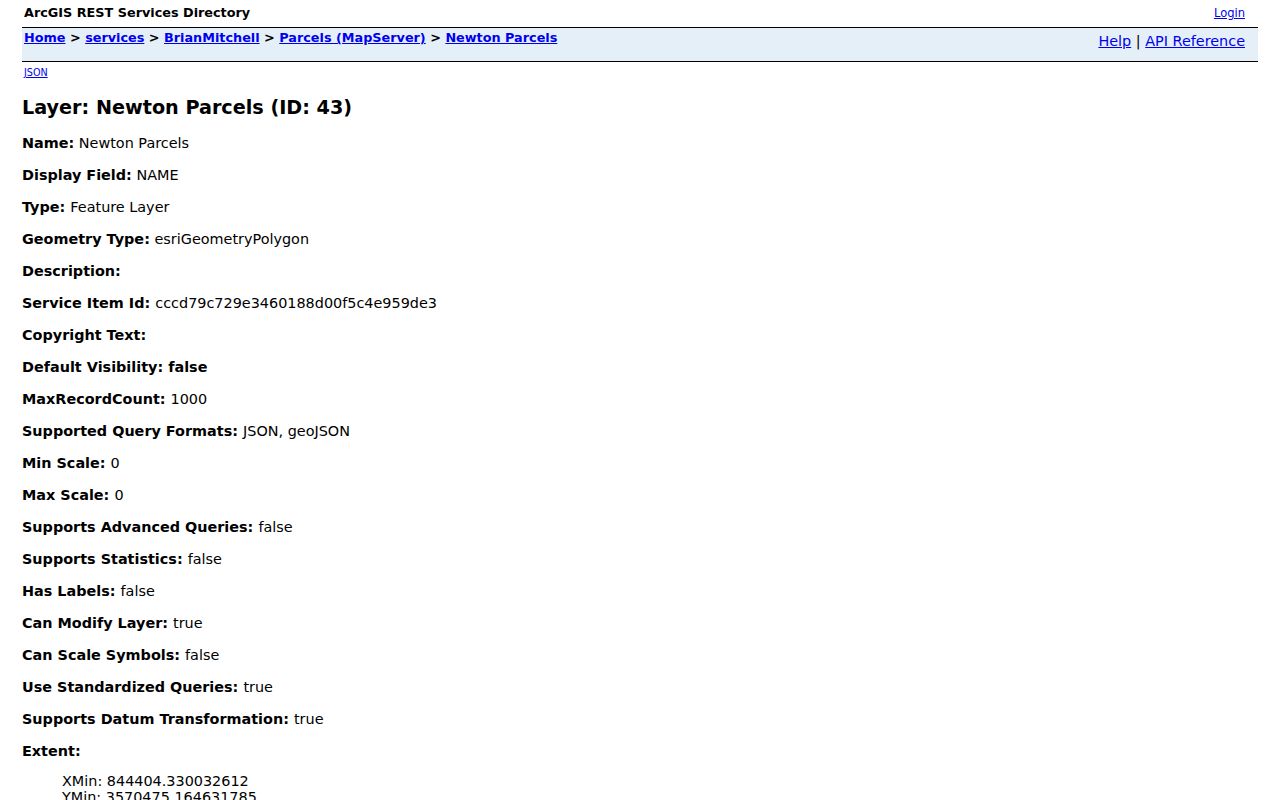
The Newton Parcels view places value, deed, sale, owner, and legal-description attributes side by side. Those neighboring fields still serve distinct purposes, so read each one for what it actually records.
Estimate Newton County Property Value From the Roll
Start any estimate from the exact parcel, then read the assessment year and its components. An address is convenient. PPIN and parcel number work better as bridges into GIS maps and deed records.
- Search Delta Property Link by address, parcel, PPIN, name, or survey grid.
- Confirm parcel and roll year, then record land, improvement, and total assessment.
- Identify the property class and ratio before comparing assessed and true value.
- Read deed and sale fields as dated clues, including SALE_VERIF.
- Roll year
- The assessment cycle for the figure.
- Tax district
- The district code attached to the parcel.
- Homestead code
- Roll treatment for that cycle, not a title trait.
Compare Newton County Sale Price With Care
The parcel schema separates sale date, price, and verification. A blank or zero can reflect several circumstances. The field itself will not say which. Pull the deed. Inspect its stated consideration and transfer context before trusting a figure. A foreclosure, estate, family, partial-interest, or court-directed deed may not resemble an open-market sale at all. That deed may not look like an open-market sale. Check the exact deed type and parties before comparing that transaction against assessed value.
Note: SALE_VERIF deserves a separate check because the parcel service stores it apart from sale date and price.
Place Newton County Assessed Value in Its Cycle
Mississippi requires real property to be revalued at least every four years. The Assessor also locates, classifies, and assesses taxable property, improvements included. A value can therefore change without a sale. Market conditions can also move without a matching roll change right away. The Assessor's office publishes no notice here of the next parcel-specific inspection. Confirm the applicable year and field definitions by calling 601-635-2517.
Keep Newton County Exemptions Separate From Value
A homestead or exemption code describes tax treatment. It applies for one roll cycle. It does not alter parcel size, title, or open-market value. DOR states that exemptions must be claimed and proven under the applicable statute. They are decided through the local process. The DOR over-65 or totally disabled homestead explanation concerns the first $75,000 of true value. It is subject to eligibility and change rules. That belongs in tax treatment, not in an estimate of likely sale price.
Verify Newton County Property Value Offline
The Delta appraisal interface sells subscription access. It opens Newton County appraisal detail beyond the free listings. Anyone without a subscription can call the Assessor at 601-635-2517 instead. Ask for current tax roll entries. Ask for prior ones too, by PPIN, parcel number, situs, or legal description. A good request names the year. It asks for class, land, improvement, and total values, plus homestead, exemption, and tax district fields. That specificity helps the office pull the right parcel quickly.
The needed record may not be available that way. The Mississippi Public Records Act offers another route. A written request can describe the record and the format preferred. Expect fees tied to actual search, review, duplication, and mailing costs.
Compare Newton County Property Values Across Years
Use the same parcel key and the same line items for every year. Record land, improvement, total assessment, class, homestead or exemption code, tax district, and roll year. Note deed and sale fields separately. A rise in total assessment may come from revaluation, an improvement, reclassification, or correction. A flat assessment does not prove the market stood still. Property descriptions matter too. A parcel split, combination, acreage correction, or new subdivision lot can make two years look comparable. But they may cover different land. Match PPIN, parcel number, legal description, subdivision, deed book and page, and GIS geometry. If the parcel key changed, ask the Assessor for the predecessor and successor records. Do not join figures by address alone. Record tax districts and exemption treatment as context. Do not use them to rewrite true value. They affect taxation through different steps. Likewise, the January 1 owner shown on a statement identifies only the roll's owner date. It says nothing by itself about the valuation date or a later recorded deed.
Test a Newton County Value Against Record Context
A recorded deed gives you a real transaction point. Before leaning on it, confirm the sale conveyed the full parcel. Check whether the source flagged the record as verified. Some deeds carry special conditions. Estate, family, foreclosure, trustee, commissioner, and partial-interest deeds all work differently. An open-market deal does not carry those conditions. So read the deed type closely. The consideration language matters just as much.
Improvement records can explain why a Newton County value shifted. Newton and Decatur both route building permits through their municipal offices. A permit, though, shows proposed or approved work, not an assessed amount. Hickory publishes no public permit search. Ask the city office for the permit. Ask the Assessor for the value treatment, and keep those answers separate.
Flood maps, historic inventories, roads, and city boundaries add land-use context without setting price. Tie any historic listing to the current parcel before comparing it. Match a flood overlay against current regulatory sources too. Each one can shape a buyer's analysis. None of them becomes an official county valuation.
Know What Newton County Assessed Value Cannot Prove
An assessed value exists to serve the tax system. It is not a survey. It is not a title opinion, a condition report, or a forecast of what a buyer will pay. Historic designation does not automatically set a value either, so pair any historic-resource entry with the current parcel and its Newton County assessment before drawing conclusions.
Value is not price. Newton County assessed value is for taxation and is not what the property would sell for or an independent appraisal.
For a current market opinion, use a qualified appraiser. Verify official values with the Newton County Assessor, and compare dates and sources rather than forcing the tax roll, deed records, and sale fields to agree.